AI replacement theory – a critique
ai
⚠️ Caveat:As always, I'm open to, and actively seeking, critiques. So please share your disagreements if you will. Here's an alternative opinion by Marc Brooker that seems well thought through.

I recently finished a contract and updated my job seeker profile. I didn't mark myself as available or make any job applications – I simply updated my profile. Within days I had received many phone calls from internal and external recruiters and scheduled many job interviews.
In those job interviews, I deliberately avoided any mention of AI, to avoid biasing the conversation. Surprise (or not) – practically no one I interviewed with ever brought AI up! No, apparently those who are actually hiring software developers still care about software development skills. Not only (or even primarily) AI prompting skills.
- If AI is already replacing engineers, I'm not seeing it yet. And we're already 2 months in to the new year!
- If AI is about to replace engineers, I suppose it must go in the "hasn't happened just yet" bucket, along with nuclear apocalypse, US debt default and widespread self-driving cars.
Surprise (or not) – practically no one I interviewed with ever brought AI up!
What the numbers say about jobs#
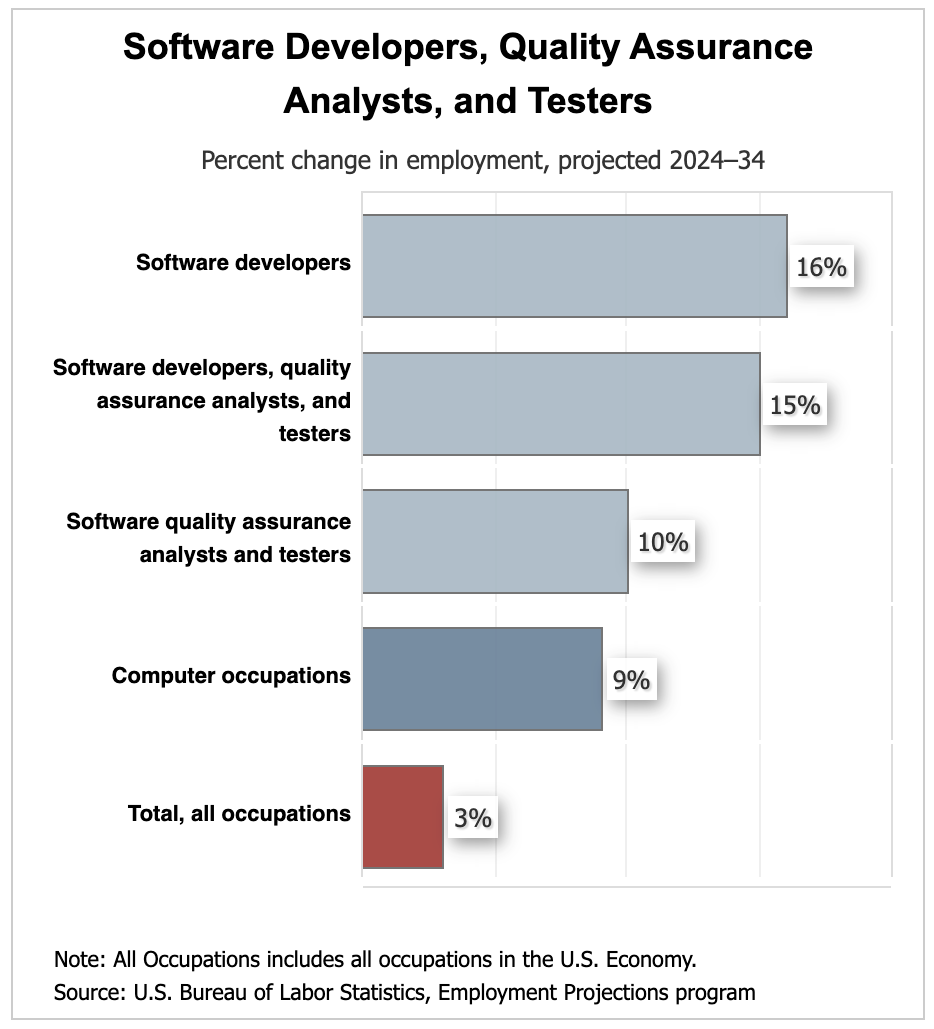
In the US, the BLS projects 15% growth for software developers, considered "much faster than average". (ChatGPT helped me find that 🙂)
The story is similar in Australia and India.
“The unemployment rate has been a little lower than expected and measures of labour underutilisation remain at low rates. Growth in the Wage Price Index has eased from its peak, but broader measures of wages growth continue to be strong and growth in unit labour costs remains high.”
– Media Release • 3 February 2026 • Monetary Policy Board • Reserve Bank of Australia
If statistics don't lie, software developers are at most being augmented rather than replaced.
Broadly, wages are steadily rising, at least in developed countries like Australia and the US. This is likely driven up by the high demand for a diminishing supply of workers.
There is, in fact, enough work to go around.
Throughout the developed world (and also in some developing countries) the human population is ageing. As pointed out by economist Charles Goodhart in The Great Demographic Reversal, the working age population is decreasing relative to the retiree population. This increases demand for labour and thus provides an incentive for governments and corporations to seek labour substitutes. AI is seen as a possible solution, and thus hyped up. The working person sees the hype, buys into it, and feels precarious. In reality, this is a mis-perception. There is, in fact, enough work to go around.
What's actually happening#
It's hard to get more specific statistics or other hard evidence to understand what's really happening.
But here are a few hunches, based on my own observations:
- 🧠 Inertia. Humans resist change. Most businesses are run by groups of humans. So, unsurprisingly, hiring strategies lag AI considerations simply because so many people have not mentally caught up yet.
- 💥 Disruption. It's true that some businesses are undergoing massive short-term change and laying off hundreds of workers. For example, some traditional banks are being disrupted by Fintech and even some tech firms are themselves being disrupted by other tech firms. There is nothing new or distinctly "AI-ish" about all this disruption. It is known as creative destruction and is baked in to the capitalist mode of production.
- 📈 Growth dynamics. Modern growth-based markets are not a straight-forward supply demand story. Supply can create more demand, as new industries and patterns of work are established and gain momentum.
- 🪖 Switching costs / risks. Businesses cannot, or are unwilling to, take the risk of immediately decommissioning legacy systems and switching to AI. As long as legacy systems stay in place, legacy engineers are needed to maintain them. For example, banks are still known to run their settlement systems on old versions of Java and Oracle.
- 🗑️ Technical debt and concept drift. While AI can initially add a lot of high quality value fast to a software project with pre-existing strong foundations, as with human developers, small mistakes can be made. These can accumulate over time, leading to an overall decline in quality or "tech debt". If there is a large amount of complex code containing subtle errors, it is not obvious that AI can tools can clean it instead of humans. AI models also have a somewhat similar issue of concept drift, where the model lags changes in the real world which invalidate its outputs.
- 🔧 Complexity of AI. Consumer-focussed AI tools like ChatGPT are simple enough for a child to use. But businesses-oriented AI tools, such as coding assistants (e.g. Claude Code), are more complex and require careful, structured, specific prompts and/or other context to be provided. The complexity level of using these AI tools is on a similar order to traditional software development, and in fact, could be considered a form of software engineering. There is now an emerging discipline known as "prompt engineering" with long books and multi-day courses. The Reductio ad absurdum is that if AI can do anything instantly, if prompted correctly, then every human on earth should just instantly become a prompt engineer and earn billions of dollars.
- 🤚 Limitations of AI. Coding might be automated, but coding is rarely the only task developers are hired for anyway. There are certain general tasks AI still cannot really do. To give a very mundane example: swiping a card at security gates, selecting an elevator floor, entering a meeting room and conversing with the attendees in a human way is not yet widely performed by talking humanoid robots at a reasonable price. Some businesses still require such manual, physical processes, and thus, still need to hire a real human to be perform them. Yes, this is still the case in 2026. If you question why this is the case, please refer back to my point on Inertia.
- 👉 Accountability. Humans can be made responsible and held accountable for achieving business outcomes. The carrot of recognition (promotions, wages, reputation, etc.), and the stick of firing, are used to incentivise employees to perform. AI does not work this way. With AI, you get what you choose and pay for, but with no built-in accountability if things go wrong. Nassim Taleb calls this "skin in the game" and it is integral to how much of the economy functions. The need for someone to hypothetically "point the finger at" is a key reason many (arguably, most) individuals are keeping their jobs, even in cases where AI might replace a lot of what they do.
The Reductio ad absurdum is that, if AI can do anything instantly (when prompted correctly) then every human on earth should just drop everything and immediately become a prompt engineer, earn billions of dollars and retire early.
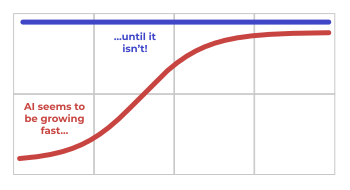
Taken together, these hunches would seem to predict a "short-term growth with long-term limits" scenario. Rather than a straightforward exponential growth curve, an S-curve with initial growth followed by tapering off as limits are realised might be more accurate. A logistic function, if you will (which I learned about from studying calculus).
Why do people think AI is replacing them?#
The narrative of AI replacing engineers is rampant.
Here are a few of my hunches on why this narrative persists:
- Attention-grabbing. Anyone with an interest in catching attention / eyeballs can find a use for emotional narratives like total replacement. Psychology has known for some time that, due to loss aversion / threat bias, people focus on negative news and threats more than on positive new developments. So they focus on narratives of replacement over narratives of augmentation or progress.
- Interested parties. Executives with a mandate to minimise budgets, private equity firms and AI startups trying to raise capital for big expensive projects, AI engineers selling themselves to the above. All have an incentive to minimise costs. Since labour is typically the most expensive cost of doing business, it makes sense they turn opportunistically to replacement over augmentation.
- Broad definitions of AI. An AI engineer who is trying to provide a serious definition of AI might define it fairly narrowly as machine learning technology, using terms such as LLMs, neural nets and transformers. But the business and consumer tech worlds define it far more broadly – from self-service food ordering apps to smart watches. Do food ordering apps replace human waiters? Yes, possibly. But do they replace software engineers? It seems more likely that they generate demand for software engineers – someone has to implement and maintain those apps. The point is: defining AI too broadly makes it appear (to some) that it is displacing technologies and skill sets that, in fact, it is not.
- Efforts to replace labour. As discussed earlier, many economies are undergoing a contraction of the labour force. This naturally generates interest in any solution to bridge the gap between supply and demand for workers. AI is easy to sell as a solution for cash-strapped governments and corporations which cannot afford to massively invest in working-age life extension to keep the elderly in the workforce and have so far failed in attempts to incentivise people to reproduce. The story of AI replacing jobs is not about reducing the number of job openings, which are already in excess of suitable applicants, but rather, filling the empty jobs that no human seems to want to do!
Conclusion#
AI adoption might initially be on an exponential growth curve, but on further investigation, there may be limits to that growth.
- Inertia: humans resist big sudden changes.
- Disruption: change is to be expected anyway, independent of AI or replacement.
- Switching costs and risks: legacy sometimes makes better business sense.
- Technical debt and concept drift: coding errors accumulate, models drift from reality.
- Complexity of AI: AI itself can require human maintainers.
- Limitations of AI: AI cannot currently fill all available jobs, even if we all wanted it to.
None of the above is meant to suggest that we should ignore AI, hesitate in investigating and adopting AI where it fits or reactively try to stop AI. It seems premature to assume that AI will replace traditional software developers or development, and much less that it will eliminate altogether the demand for highly-skilled and appropriately compensated human labour.
Further reading and watching#
- Blog: Don't Let AI Dull Your Software Engineering Edge • Andy WONG
- Blog: The Eternal Promise: A History of Attempts to Eliminate Programmers • Ivan TURKOVIC
- Blog: Coding is NOT solved • Alex EWERLÖF
- Video: The software dev job market is picking up! • Maximilian SCHWARZMÜLLER
- Video: AI Is Not Improving Productivity • Daron ACEMOGLU
Alternative opinion: