⚠️ Disclaimer:The information and the links provided here are for general information only and should not be taken as constituting professional advice. You should always seek professional advice and do your own research when making any financial decisions.
ℹ️ TL;DR:eTIBs, bought directly and held to maturity, can help to protect you against medium-to-long-term inflation in Australia, sitting between cash (short-term) and equities or other risk assets (long-term).
There is much general discussion about inflation. Recent years have seen higher-than-average inflation rates on basic goods and services such as food and housing, both in Australia and abroad. In my own search for inflation protection, I stumbled upon an interesting solution available to retail investors like me.
Australian eTIBs or Exchange-traded Treasury Indexed Bonds are government bonds issued by the Australian Government (specifically, the Treasury). These bonds function similarly to US TIPS or UK Indexed Gilts, with inflation-adjusted coupon payments and principal upon maturity. They are denominated in Australian Dollars (AUD) and indexed according to Australian CPI.
These are very safe government bonds and are available for purchase to all Australians (anyone with access to the ASX, in fact) in amounts that are affordable for individual investors. If you want to protect a fixed sum (or sums) of money from inflation, over a fixed period of time, eTIBs may be a good solution for you.
The mechanics of these bonds are explained in various online resources, including an Australian Government bonds course on the ASX website. I thought I'd describe them here, in my own words, both for my own understanding and hopefully yours too!
eTIBs and units#
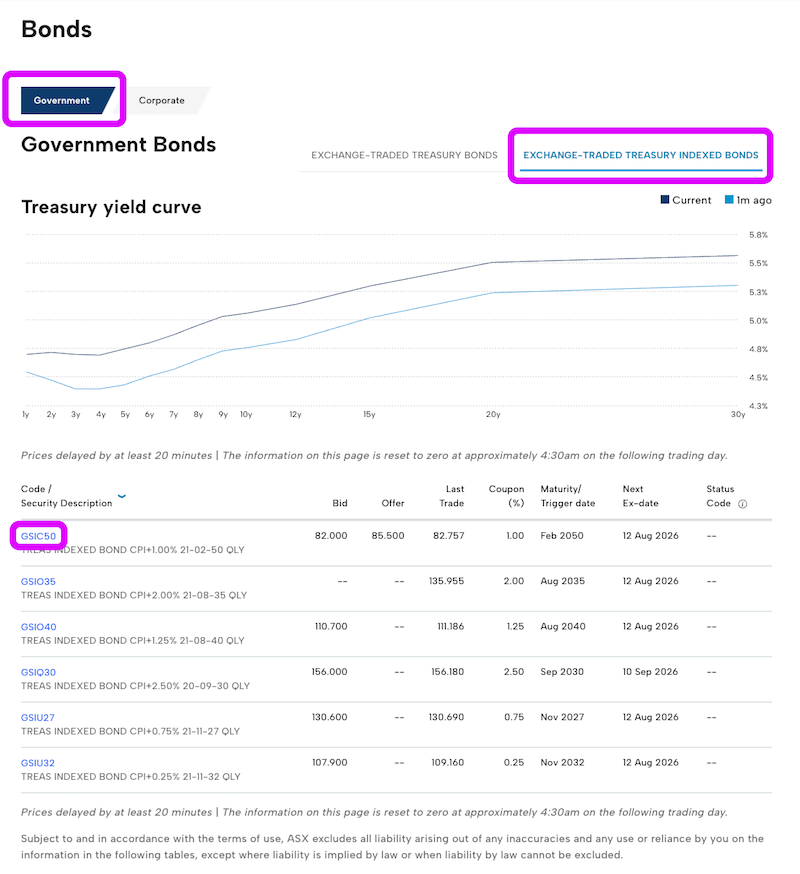
At the time of writing, there are 6 eTIBs in circulation:
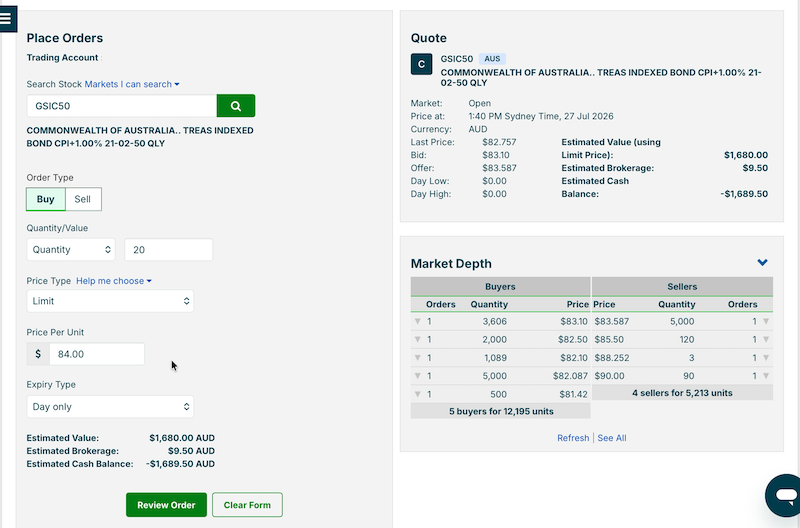
eTIBs are bought and sold in units, with each unit constituting an original face value of $100.
eTIBs are bought and sold on the ASX (Australian Stock Exchange). Anyone with access to the ASX can buy and sell them. As with regular stocks and bonds, this can be done through a low-fee online broker, such as SelfWealth or Interactive Brokers. You can find short training videos to help with this, such as How to Buy and Sell Shares from Selfwealth Tutorials.
Coupons and principal on maturity#
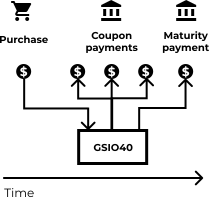
An eTIB unit, bought and held for its full duration, provides the following income:
- Multiple coupon (interest) payments
- One maturity payment
The coupon payments are made quarterly (that is, every 3 months). They continue for the time that you hold the bond, up until its maturity. The amount of each coupon payment is a percentage of the adjusted face value divided by 4 (since there are 4 quarters per year). Each bond pays its own specific coupon rate (percentage).
The maturity payment is made once, on the date the bond matures. Each bond has a maturity date. For example, GSIC50 will mature on the 21st of February, 2050. The amount of the maturity payment is the whole adjusted face value.
The coupon rates and maturity dates are outlined in the term sheet for each bond (and broadcasted widely). The term sheets can be found in the list of Available exchange-traded Treasury Indexed Bonds on the Australian Government Bonds website.
These payments are made into your personal bank account registered with CHESS at the time of the payment, typically your broker's account. I can personally verify that the payments are indeed made and that I have received exactly the expected amounts into my bank account.
Face value adjustment#
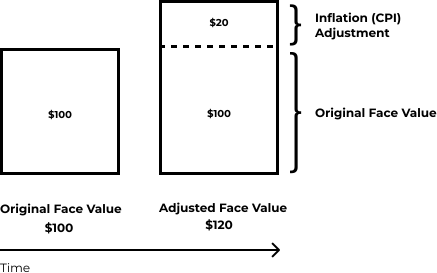
Each eTIB has two face values:
- An original face value of $100
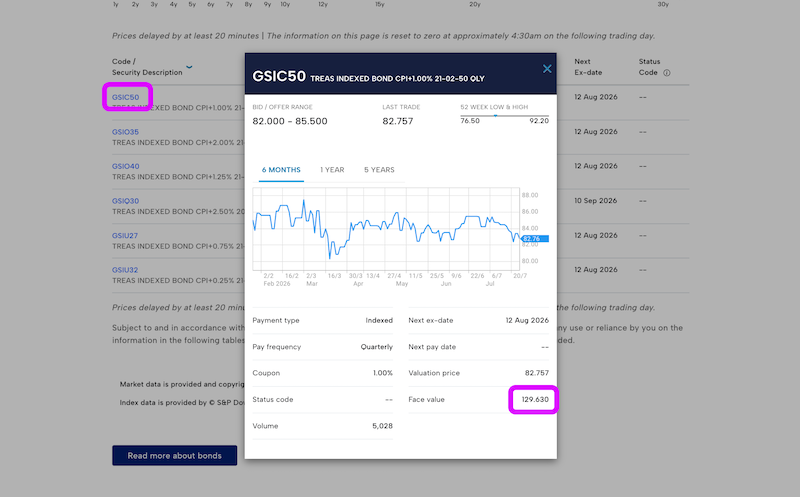
- An adjusted face value of $100 + an inflation adjustment
The original face value is fixed and never changes for the life of the bond. It represents the minimum value of the bond. No matter which direction the inflation rate goes – either up or down – you are guaranteed to receive coupons and principal repayment on maturity of at least $100 original face value per unit.
The adjusted face value, in contrast, changes each quarter, according to the increase or decrease in inflation (CPI) over the prior quarter.
For example, suppose we bought one unit of an eTIB with an adjusted face value of $110 in the first quarter of the year. By the end of that quarter, inflation had increased by 2%. Then the adjusted face value would be $110 + 2%, which is $112.20.
It is the adjusted face value (not the original face value) that is the basis of the coupon and maturity payments. This value provides the inflation protection, as it increases according to CPI over the lifetime of the bond.
The current adjusted face values for all eTIBs can be found on the Bonds - prices page under the Exchange-Traded Treasury Indexed Bonds tab on the ASX website.
Face value vs price#
eTIBs are bought and sold at market prices. Depending on supply and demand, each eTIB will be available for a different price per unit at a different time.
Unit prices vary over time, but tend to hover around the $100 mark. There are certain patterns: typically shorter maturing eTIBs are priced above $100, while longer maturing eTIBs are priced below $100. (There is some theory as to why bonds are priced in this way, linking it to factors such as economic forecasting and investor habit-formation.)
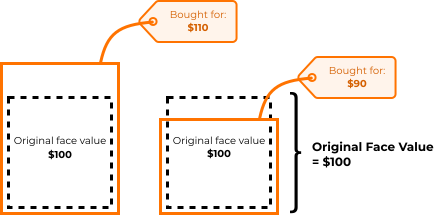
To determine how much inflation protection you received, for a given sum of money invested into eTIBs over a given time period, you would need to take into account the price you paid. For example, if you pay a price of $110 for an eTIB, and it subsequently matured with an adjusted face value of $150, then you would have received $150 - $110, which is $40, of inflation protection in that maturity payment. You would also have received additional protection in the form of any coupon payments you received for quarters when the adjustment was positive.
What's the catch?#
There are various risks and downsides to eTIBs that you should be aware of.
Here are a few I've identified:
- High price at purchase
- Price volatility while holding
- Re-investment risk when rolling over
- Inflation decreases
- Sovereign credit risk
- Policy change
- Currency devaluation
- Individual inflation
- Tax
- Maturity gaps
High price at purchase
There is a risk that you will not find a bond that is priced such as to give you a positive overall return.
In this case, you might find yourself having to pay a penalty for inflation protection: the difference between the price you pay upfront and total return of the bond (coupon + maturity payments). If this penalty turns out to be higher than the inflation protection provided by bond, you will realise a negative total real return.
For example, if today you bought an eTIB priced at $150 maturing in 5 years with an interest rate of 1% and an adjusted face value of $120, then you would be "locking in" a negative real return on that eTIB. It wouldn't matter how high (or low) inflation was over the coming years. You would be guaranteed to make a loss. Including interest payments, you would get back approximately $126.12, which is still less than you invested, in today's dollars. No amount of inflation adjustment make up the difference in price and adjusted face value plus coupons.
Of course, it is impossible to forecast future inflation with total certainty. If you want the certainty of some amount of money being protected, even if it's less than you invested up-front in real terms, then you might still choose to go ahead with the purchase. But you should be aware of what the cost you'll be paying for that safety.
Price volatility while holding
If you want safe inflation protection, you should plan to hold eTIBs to maturity without ever selling.
If you sell, you may get a lower price than you originally paid, which undermines or eliminates the inflation protection. eTIBs work best when purchased and held for their entire duration. When the bond matures, you will receive the full maturity payment automatically.
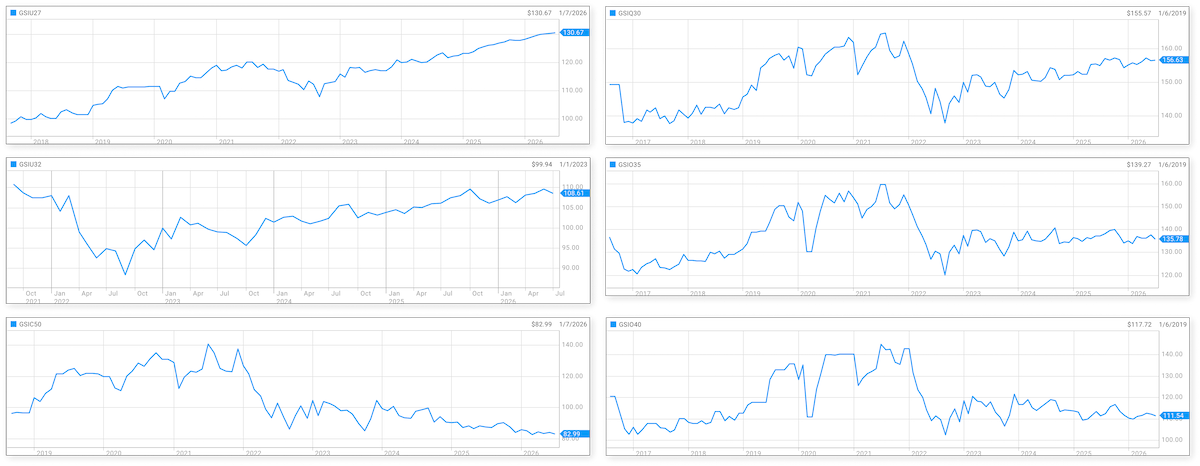
Price histories of all eTIBs can be found on the ASX website.
Re-investment risk when rolling over
What if you plan to "roll over" your eTIB, on maturity, into a new eTIB in a latter period?
For example:
- You, in the year 2026, buy GSIU27, which matures in the year 2027.
- You, in the year 2027, receive the maturity payment of GSIU27. Say, a total of $1,000.
- You then invest that $1,000 into GSIQ30, which matures in the year 2030.
The problem here is that, for reasons covered in the previous section, you might not get a good price when you go to buy your next eTIB. So potential losses from future planned re-investment will need to be taken into your account in planning.
I can think of 2 ways to mitigate this risk:
- Plan to use some investments from higher-expected-return assets, such as an equity index fund, to cover future price penalties. This could work well especially at a 10+ year time horizon, where equities are more likely to have delivered significant real returns.
- Buy your whole bond ladder (or as much of it as you can) early on, if prices are reasonable, to lock in lower prices and higher yield. This strategy works well but requires significant luck. Specifically: you need to be lucky to have a lot of capital to invest and you need to be lucky to be investing at a time when prices are low.
Most individuals will probably want a little of both: use some portion of equities or other risk assets to fund future eTIB purchases at higher prices and opportunistically buy eTIBs that match your investment goals at low prices if/when they become available.
Inflation decreases
What if inflation goes down during a deflationary period?
In that (albeit unlikely) case, you will continue to receive coupon payments as a percentage of newly adjusted face value. But you will not be compensated for any negative difference between the price you originally paid for the bond and its current adjusted face value.
For example, if you bought a bond at a price of $110 with an adjusted face value of $120, but inflation went down by 10% over the following quarter, the newly adjusted face value would be 120 - 10%, which is $108. You would not be compensated for the $2 difference between the purchase price you originally paid ($110) and the new adjusted face value ($108). For this reason, it's best to diversify your safe assets. Rather than relying solely on eTIBs, you might hold some mixture of eTIBs, regular bonds, cash and various other safe assets.
Alternatively, you can simply accept that you might lose some money in a deflation and make your calculations include the possibility of a "worst-case" scenario. If you invest enough into eTIBs that you still have a substantial amount without the inflation adjustment, then at least you have met your goals, even if you ended up losing money.
In the planning spreadsheet I share at the end of this article, you can find columns for "worst case" (deflationary), "best case" (inflationary) and "average" (average of worst and best) scenarios.
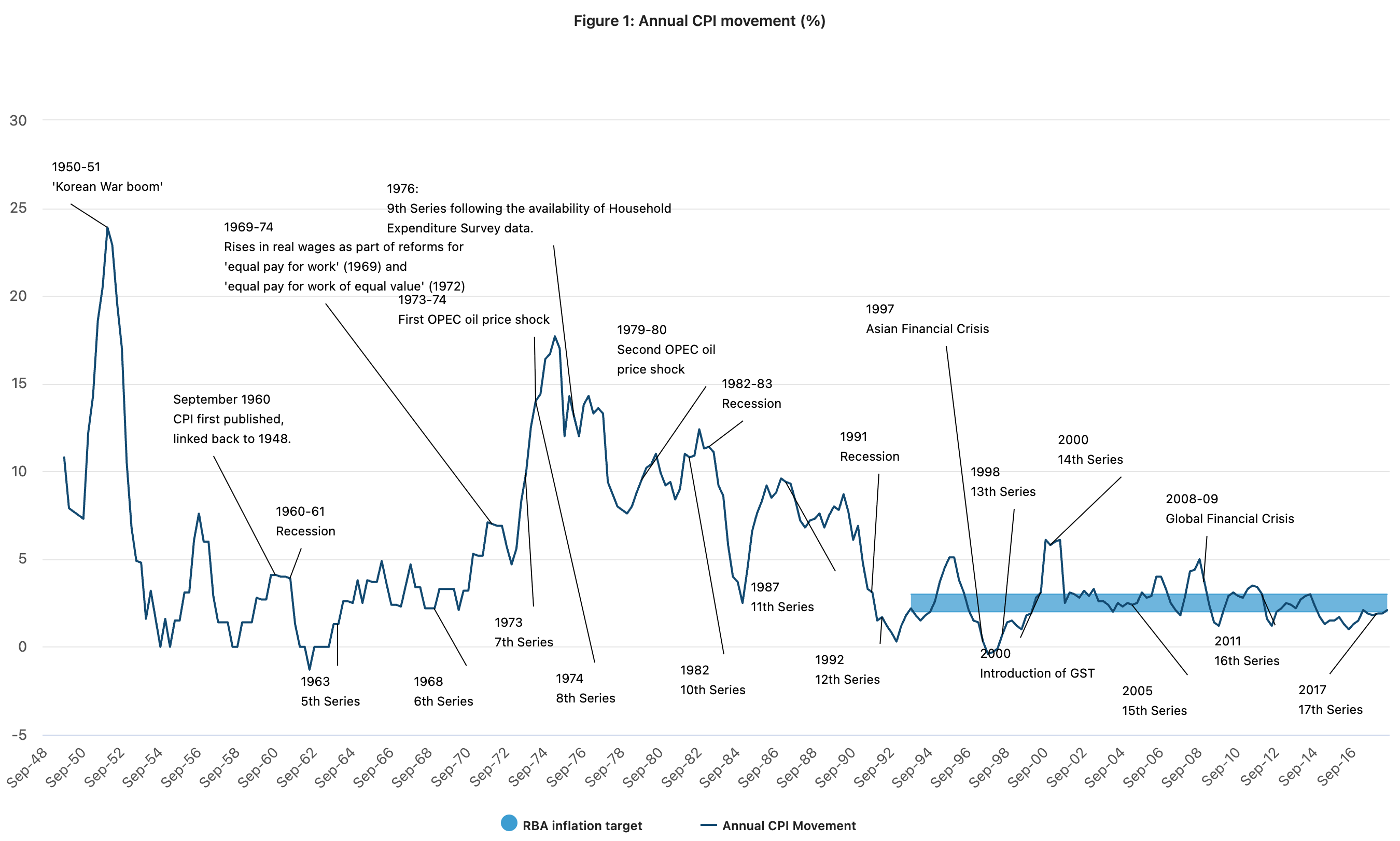
Historically, inflation has very rarely gone negative. During periods of price stability, which is most periods so far, inflation is above zero. The rate of increase of inflation can increase or reduce, but prices do still net increase very gradually. This is a "steady state" that the Reserve Bank deliberately targets, to meet its mandate of maintaining price stability. Even in a disinflation (a reduction in the rate of increase of inflation), your eTIBs will continue to provide inflation protection.
“In deciding where to set the cash rate, we want to keep inflation low and stable, averaging 2-3 per cent – our inflation ‘target’, if you like. But we want to do it in a way that keeps the level of employment as high as possible.”
– Our Role and Functions • Reserve Bank of Australia • Michelle BULLOCK
Sovereign credit risk
Australian government bonds are very safe assets, issued by a government with a world-leading credit rating. Relative to other governments, Australia is ranked highly by prominent ratings agencies such as Moodys and Fitch.
Bond defaults, while extremely unlikely, are possible, of course. So are extreme weather events, serious health issues, etc. One must balance the risks of inflation protection against other risks including the risk of inflation itself – inflation is highly likely to continue, at least moderately, as it is part of the Reserve Bank's target.
Policy change
Government policies can and do change over time. Changes in bond issuance and payments, taxation of bond income and changes in calculation of CPI itself (as noted in an interview with Laurence Kotlikoff) could all impact your eTIBs.
Of course, policy changes need not always be adverse. Some might even be beneficial. For example, the recent changes mentioned in the Tax section in this article might actually benefit the inflation protection of eTIBs.
Currency volatility
The Australian Dollar (AUD) functions well within Australia itself, with our robust payments system. But it has undergone a long period of decline relative to prominent overseas currencies, such as the USD, GBP and EUR.
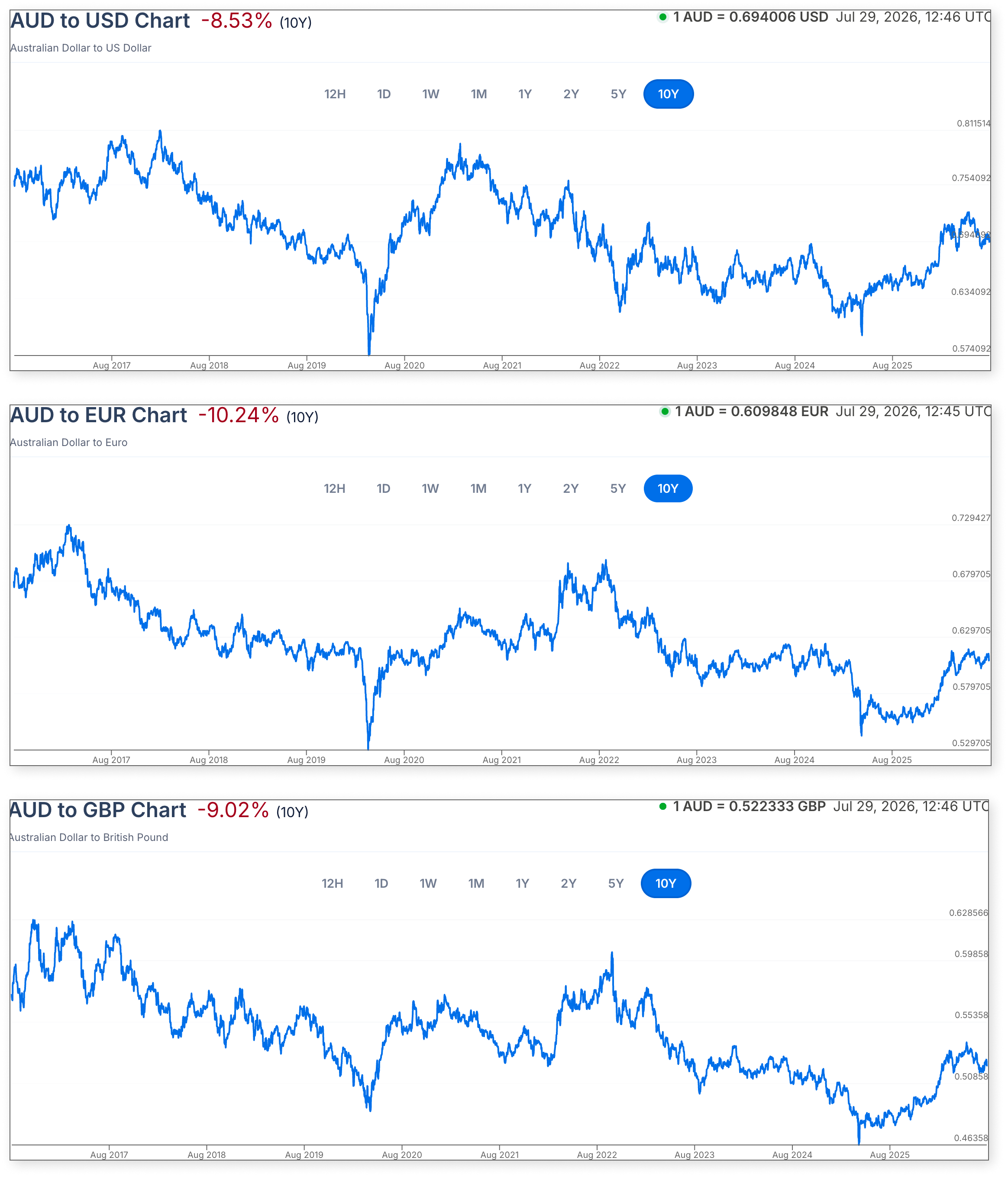
Also the Australian dollar has tended to depreciate when its own stock market falls, making it a poor safety net at these times for an investor with liabilities in foreign currencies
“Investors in the Australian and Canadian stock markets are keen to hold foreign currency, regardless of the particular currency under consideration, because the Australian and Canadian dollars tend to depreciate against all currencies when their stock markets fall; thus any foreign currency serves as a hedge against fluctuations in these stock markets.”
– Global Currency Hedging • Journal of Finance • John CAMPBELL
On the positive side, Australian dollars have appreciated at times, such as during periods of high commodity demand. And Australian interest rates are among the highest in the world.
If you plan to spend most of your time living in Australia, and keep your short-term savings in high interest accounts, currency devaluation isn't a real risk. If you want to spend significant amounts of time abroad, you might want to think again and diversify your stock and fixed income globally. For inflation protection in other currencies, there are foreign inflation-linked bonds, such as US TIPS, UK Indexed Gilts and/or the various European and Asian indexed bonds.
Individual inflation
Inflation protection from eTIBs is based on the Consumer Price Index (CPI), which is adjusted each quarter and published regularly by the Australian Bureau of Statistics (ABS).
The percentage of inflation is calculated based on the prices of a hypothetical "basket of goods", meant to represent a typical person's consumption over a year.
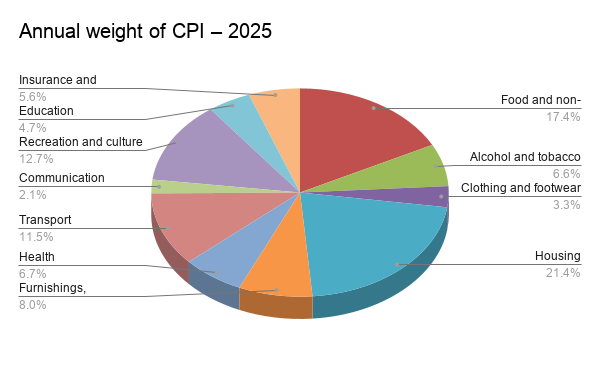
There is a risk that your own individual, personal inflation rate might differ substantially from the official CPI, because your personal "basket of goods" might be very different than the official CPI basket.
For example, in the year 2025, the ABS weighted housing at 21.39% of the overall basket. This might have been close to what most Australian home-owners were spending on home maintenance at the time. But if you were in the then-minority of renters, you might have been spending significantly more than that.
There can be mitigating factors to such an imbalance, however.
- Inflation in one group may "flow" through to other groups. For example, if the cost of real estate overall increases, it can flow through to your supermarkets and petrol stations, which after all also occupy real estate, and thus be reflected in those prices.
- Inflation extremes may even out over time. For example, a temporary spike in fuel costs may be temporary and eventually moderate.
- You might figure out ways to reduce your own spending in one or more groups, bringing your spending more in line with the CPI basket. This factor is probably the one most in your own control.
Tax
Depending on your situation, eTIB income may fully taxable, similar to employment and dividend income.
“Interest withholding tax applies to interest payments (within the meaning of section 128A(1AB) of the Income Tax Assessment Act 1936) to an eTIB Holder.”
– Investor Information Statement • australiangovernmentbonds.gov.au
Under current tax rules (mid-2026), capital growth on your eTIBs is also likely subject to Capital Gains Tax (CGT), which would be payable if you sell a bond at a gain or a bond matures and you receive the principal adjustment realised as a capital gain.
However under upcoming tax legislation, the capital growth component of eTIB income may cease to be taxable. This is because, assuming capital growth is exactly equal to inflation over the period of holding, it would be excluded from the 30% minimum tax on capital gains. This is outlined in the Budget Explainer 2026-27 under the Cost base indexation section (pp. 2).
Maturity gaps
There are, unfortunately, long gaps between the maturity dates. For example, there is a 5-year gap between the maturity of GSIO35 and the maturity of GSIO40. During those gaps, the return from the prior period needs to be held in some form that won't be eroded too much by inflation. This is a real problem if you will be relying significantly on maturity payments.
(If you're a multi-millionaire, then I suppose you can afford to live off only the interest on a long bond. But in that case, you might have enough to live off cash, without the hassle of setting up a bond ladder!)
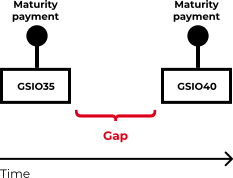
One idea is to hold them in an interest-bearing cash account, such as a High Interest Savings Account (HISA) and/or Term Deposits. Additionally, some funds could be re-invested into later eTIBs. This is described in more detail in the Ladder strategy section of this article.
Where eTIBs fit into a portfolio#
“The long term is made up of many short terms.”
– Ronnie COLEMAN
Where do eTIBs best fit into a portfolio with multiple asset types, to minimise the impact of inflation?
I would say they fit snugly between cash in a savings account and riskier assets such as real estate or stocks.
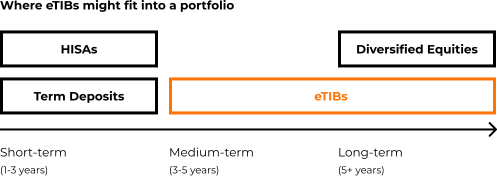
Cash provides a "good enough" short-term inflation hedge, if invested at the highest possible interest rate, such as in a High Interest Savings Account (HISA) or Term Deposit. Banks will tend to increase the interest rates on cash savings during periods of high inflation. This is a flow-on effect of the Reserve Bank raising interest rates in response to inflation, and was evidenced by the Reserve Bank's recent cash rate increases.
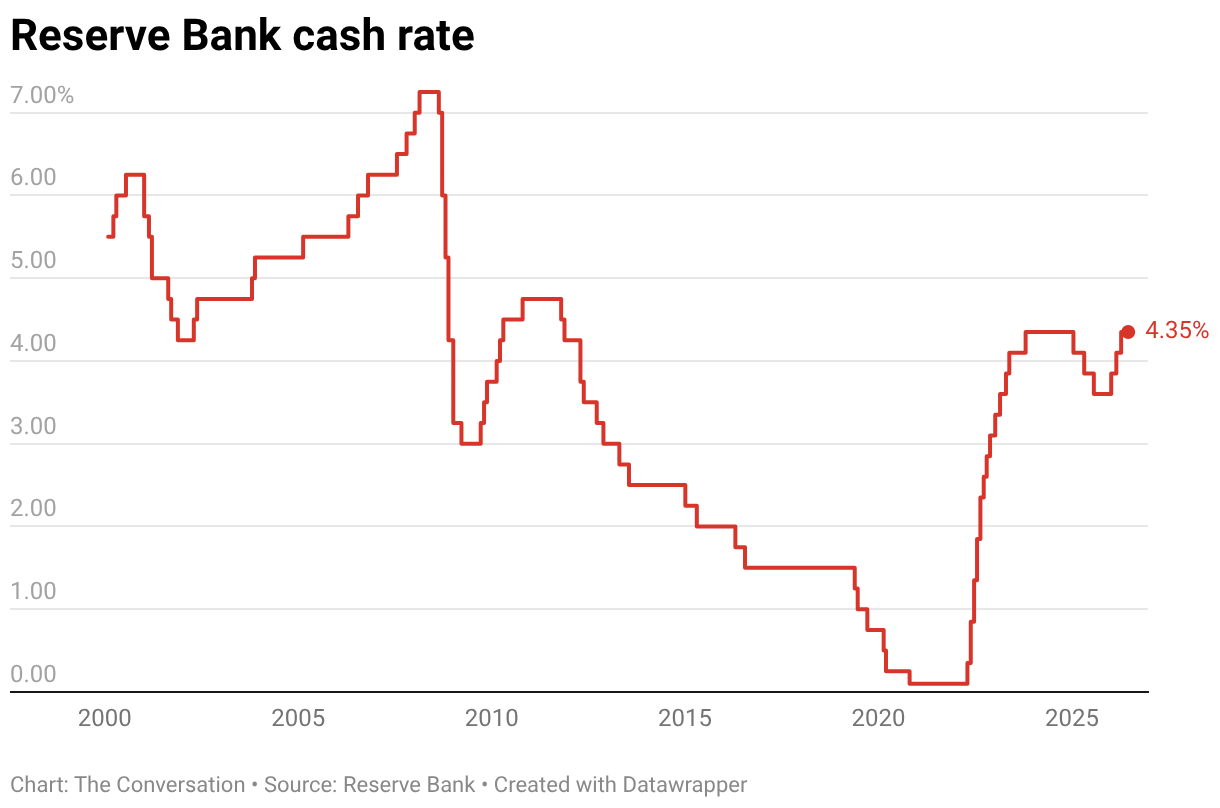
However, cash you save today will likely be heavily eroded by inflation 5-10 years later. This is because the Reserve Bank of Australia (RBA) deliberately targets long-term mild inflation in order to maintain full employment (at the time of writing). Even a modest inflation rate compounds over time. So while 3% inflation might not seem like much, compounded over 10 or more years, it will reduce your $100 savings to only around $73 (100 * ((1 - 0.03) ^ 10) ≈ $73.74).
Diversified equities in a low-cost index fund provide long-term protection against inflation. This is backed up by strong theoretical and empirical evidence. Ben Felix discusses this at length in a video on inflation protection.
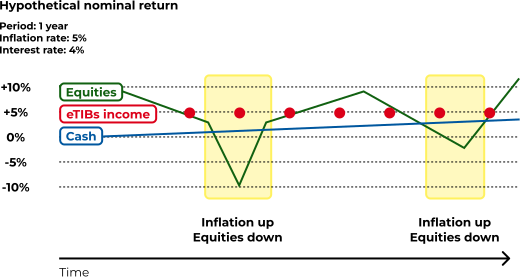
However, equities do not always and reliably hedge inflation. Stocks are volatile and can undergo periods of downturn. Worse, periods of high unexpected inflation and low GDP growth, equities have been volatile and even seen negative real returns.
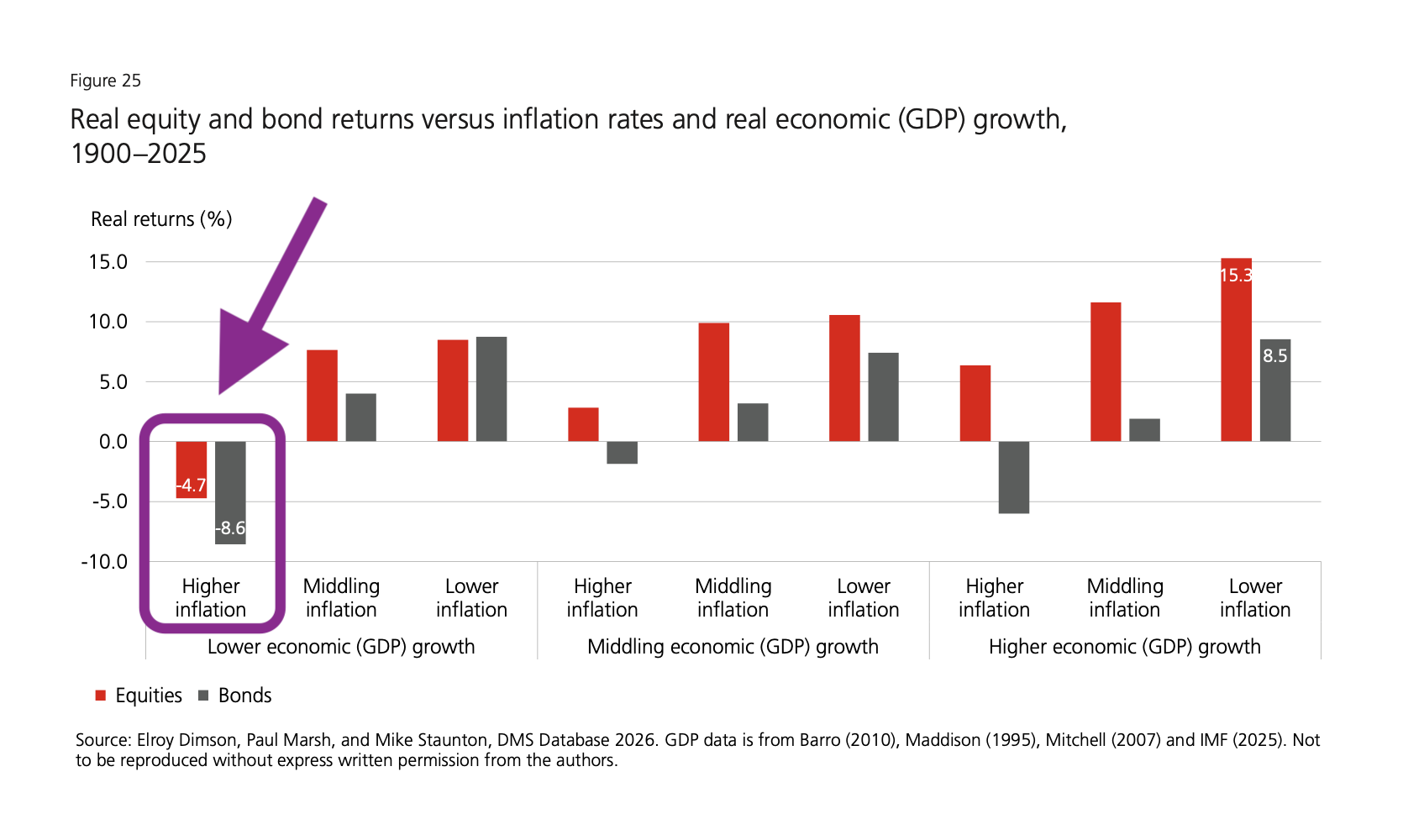
“Although it is often claimed that equities are a hedge against inflation, we find that for both equities and bonds, real returns tend to be higher when economic growth is higher and inflation is lower.”
– Global Investment Returns Yearbook 2026 • Dimson, Marsh, Staunton
So you might want some "safe asset" to cover your expenses during periods when inflation is high and equities are down. Something that keeps up with inflation over the longer run but is less volatile than stocks.
eTIBs can help you to bridge the gap between low yielding cash savings and highly volatile stock markets. During periods of negative real stock returns and ongoing inflation, the inflation-protected income from eTIBs can help support your basic consumption needs.
If you're still working, this income can supplement your earned income. If you're retired, it can help reduce or eliminate your equity withdrawals, increasing the long-term safety and stability of your equity portfolio. This is the niche that eTIBs can help you to fill.
If you plan to retire early, you could use eTIBs to provide a safe floor of income between your early retirement and your eligibility for the Australian Age Pension. The protects your most critical spending (such as food and housing) in the case of a bad sequence of returns. Additionally, it reduces your drawdown on equities, allowing your equities to last longer and provide more upside during the good times.
Ladder strategy#
Unless you have a lot of money to invest, the coupon payments from eTIBs won't on their own be large enough to offer meaningful protection. One trick is to buy eTIBs on multiple maturity dates and earn inflation-protected income from both coupon payments and maturity payments. These eTIBs form a "ladder" from shortest to longest, providing income over multiple periods.
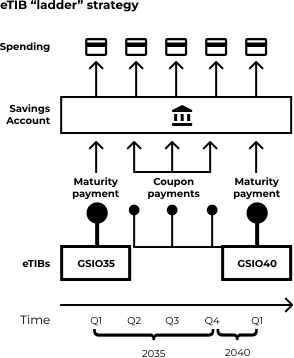
On each maturity, some of the funds are invested into the next "ladder rung" of eTIBs. These re-invested funds might not totally match inflation, but over periods of ~3-10 years, they should hold most of their value.
There is some re-investment risk, as this strategy involves future buying of eTIBs, and, over time, they might increase in price. If the eTIB income is supplemented with other income sources, such as equities, then the total can be re-invested into eTIBs. Over a 10-15 year period, the returns on diversified equities should likely match or exceed inflation. This might help to make up for future price increases in eTIBs.
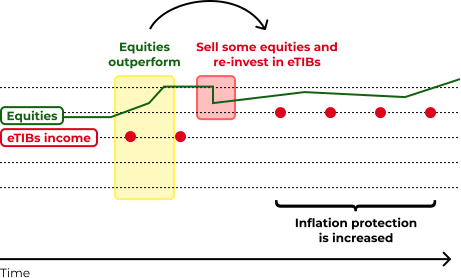
You might also take advantage of the potential upside of re-investment. For example, in years when your equities perform well, you can sell off a portion of that over-performance and re-invest it into eTIBs. This can increase the level, duration and/or safety of your inflation protected safe income.
Summary#
For what they are, eTIBs can be a very useful tool to have in your inflation protection toolkit.
They are certainly no "silver-bullet solution" to the problem of inflation. They come with risks including taxation, individual inflation risk, deflation risk and sovereign risk.
However, they do at least provide broad inflation protection according to a clearly defined metric (Australian CPI). And their income (by means of coupon and maturity payments) is uncorrelated with the returns of the stock and bond markets. This makes them a diversifier during periods of high inflation combined with market volatility. Simultaneously, with enough invested, they also provide a safe floor in case of deflation, based on the original face value.
Having some safe real income during stock market turbulence may also provide some psychological benefits and help you to avoid or minimise drawing down on stocks at the worst times.
Overall, I think eTIBs are worth looking into – either on your own or with the help of your financial adviser.
Calculating income from eTIBs#
I built a spreadsheet to calculate income on eTIBs over time. Feel free to download it and tailor it to your own purposes.
- OpenOffice • eTIB_Income_Calculator.ods
- Excel • eTIB_Income_Calculator.xls
- Google Sheets • eTIB Income Calculator

Product idea#
I think it would be great if the Finance / Fintech industry developed a more user-friendly solution for the general public. In my Ideas section, I proposed a simple Inflation-linked savings account. Maybe I'll try to build a product like this myself one day.
Further reading#
Australia-specific (eTIBs)
- Course: Australian Government bonds | ASX
- Paper: Investor Information Statement - eTIBs | ASX
- Paper: eTIBs - Course Module 4 | ASX
- Website: Investments paying interest - Bonds | MoneySmart.gov.au
- Website: australiangovernmentbonds.gov.au
General and theoretical
Some very interesting general and theoretical work has been done around inflation linked bonds. One example is the investment life cycle model espoused by personal finance economist Ben Matthew, which involves modelling investment and spending using an amortization formula and using inflation linked bonds in the implementation. Related work has been done by Kevin Esler and Zvi Bodie.